Frances Mold
The CallerFrances Mold is a fifteen-year-old from Kirkeby whose brief appearance in a local newspaper gives the police a possible explanation for how a prankster finds people to intimidate. Her account turns a routine road-safety interview and a photograph into a warning about how easily public information can expose someone to unwanted attention.
Identity and Introduction
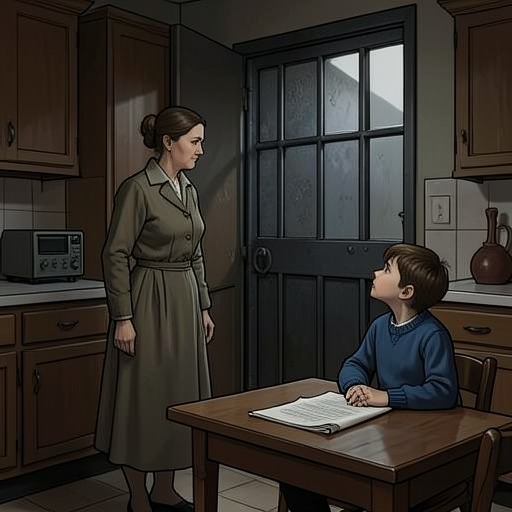
Frances is Evelyn Mold’s daughter. When her mother arrives at the hospital believing Frances may be involved in an accident, she identifies her by her full name, Frances Emilie Mold, and says she was born in 1994 and is fifteen. Frances is later seen at home in a pink tracksuit, curled into the corner of the sofa. The contrast between her ordinary, withdrawn posture and her mother’s alarm makes the false report’s emotional force visible without making Frances herself the source of the misunderstanding.
Her scooter is an important detail in the account. Her father, who lives abroad, gave it to her, and Frances and Evelyn had recently visited a dealership to choose it. Frances had been looking forward to driving, but she also took road safety seriously: the newspaper reported that she chose the most expensive helmet and pledged not to ride recklessly.
The Newspaper Profile
Fourteen days before Sejer’s visit, Frances answered questions from a representative of the Council for Road Safety at the dealership. The representative was writing about traffic safety and took her photograph. Frances had kept the newspaper and, when Sejer asked about it, pointed out the picture to him. She disliked how she looked in it, an unguarded adolescent response that sits beside the article’s more formal portrait of her as a cautious new scooter rider.
The profile identified Frances by name and place of residence, Kirkeby. Sejer explained that he believed the prankster might scan local newspapers for stories, record a person’s name and address, and then investigate further, perhaps through directory services. Frances’s article fits that proposed pattern, though the evidence presented does not establish that it was definitively how she was selected. Its mundane details—her age, home town, photograph, and new scooter—show how a celebratory local story could also supply identifying information.
The False Alert and Its Aftermath
The false hospital alert reaches Evelyn, not Frances directly. At the hospital, Evelyn says she has come for her daughter, who rides a scooter; when asked for Frances’s full name and age, she breaks down. A staff member checks with the University Hospital and realizes that something about the situation is wrong. In the later conversation at home, Frances’s saved newspaper article gives Sejer a concrete lead for understanding the deception.
The case unfolds against a public atmosphere already charged by sensational reporting. After the blood-soaked-baby prank, reporters gather outside the police department, and the headlines announce the incident as a grotesque joke and a shocking discovery. Sejer worries that newspapers may magnify a prankster’s reach by giving the perpetrator the attention sought. Frances’s profile becomes part of this broader problem: publicity can turn a private person into a usable name and image, even when the original article was simply about road safety.
Narrative Role
Frances contributes a specific piece of evidence rather than a full account of the prankster’s motives or identity. Her saved clipping connects the false alert to the suspected practice of selecting targets from local news, while her reaction to the photograph keeps that investigative clue grounded in the ordinary life it exposes. The episode shows how an apparently harmless public profile can be repurposed as a tool of intimidation; it does not, on the evidence presented, confirm that Frances’s article was the precise source used in her case.